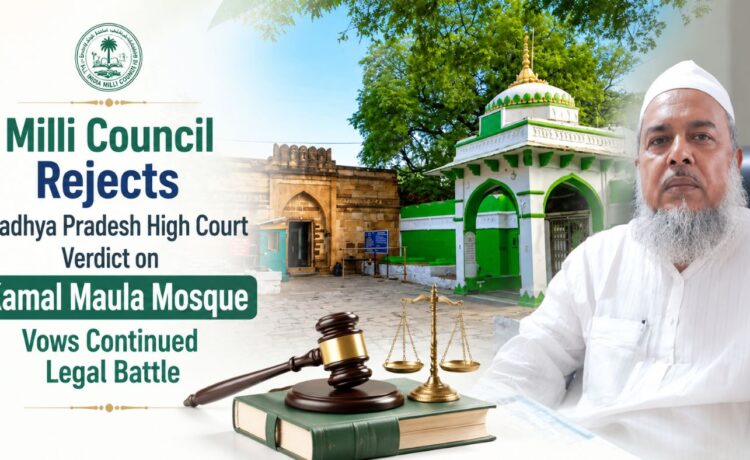
Milli Council Rejects Madhya Pradesh High Court Verdict on Kamal Maula Mosque, Vows Continued Legal Battle
New Delhi, 18 May 2026: The All India Milli Council has strongly objected to the recent judgment delivered by the Indore Bench of the Madhya Pradesh High Court regarding the historic Kamal Maula Mosque, also known as Bhojshala, in Dhar district of Madhya Pradesh. Calling the verdict “unacceptable,” the organisation alleged that the decision was based more on literary and traditional references than on concrete historical and archaeological evidence.
In a press statement issued from the central office of the council, Acting President Maulana Aneesur Rahman Qasmi expressed deep concern over the May 15 judgment, which reportedly set aside the 2003 arrangement made by the Archaeological Survey of India (ASI) concerning the management of the 11th-century Kamal Maula Mosque.
Objection to Court’s Interpretation
According to the council, the High Court declared the site to be associated with a temple dedicated to Goddess Saraswati and linked it to Raja Bhoj, despite what the organisation described as a lack of conclusive factual and archaeological proof.
Maulana Qasmi stated that the mosque, protected under the ASI, had long functioned under a mutually regulated arrangement introduced in 2003. Under that framework, members of the Hindu community were permitted to offer prayers on Tuesdays, while Muslims were allowed to perform Friday prayers at the site.
He noted that the arrangement later became the subject of legal challenges after a section of Hindu petitioners sought a complete ban on Muslim prayers at the site through proceedings before the High Court. However, following an appeal by the Muslim community, the Supreme Court of India had intervened and stayed the demand seeking restrictions on prayers.
The council further alleged that the High Court-ordered survey of the site was itself controversial. Referring to earlier directions of the Supreme Court, Maulana Qasmi said the apex court had instructed that the survey report be sealed, copies be supplied to all parties, and objections raised by stakeholders be considered during final hearings.
“The recent judgment of the Madhya Pradesh High Court is not acceptable to us in any manner,” he asserted.
Reference to Babri Masjid Dispute
Drawing parallels with the long-standing Babri Masjid dispute controversy, Maulana Qasmi said the Muslim community still remembers the prolonged struggle undertaken by senior leaders and organisations for the restoration of the Babri Masjid.
He alleged that the Babri issue had gradually acquired a political dimension and that pressure had been exerted on institutions during that period. “We should never consider withdrawal from Kamal Maula Mosque as our helplessness under any circumstances,” he said.
The Milli Council appealed for a united and legally grounded response involving “far-sighted leadership” from across the country. The organisation stressed that the legal challenge against the verdict should be pursued in light of the Places of Worship Act, 1991, which mandates the preservation of the religious character of places of worship as they existed on August 15, 1947.
“We will not tolerate any violation of the Places of Worship Act, 1991, and our struggle will continue,” Maulana Qasmi said, expressing confidence that Muslim leadership across the country would continue resisting the verdict through constitutional and legal means.
Appeal to “Justice-Loving Citizens”
The council also called upon “justice-loving citizens” and democratic voices across India to raise concerns over what it termed an “ambiguous judgment.”
Urging sustained and peaceful legal resistance, the statement said the issue extends beyond a single structure and reflects broader concerns relating to historical religious sites, constitutional protections, and communal harmony.
The organisation reiterated its commitment to continue the legal and democratic struggle against the verdict while seeking wider public support and solidarity.