

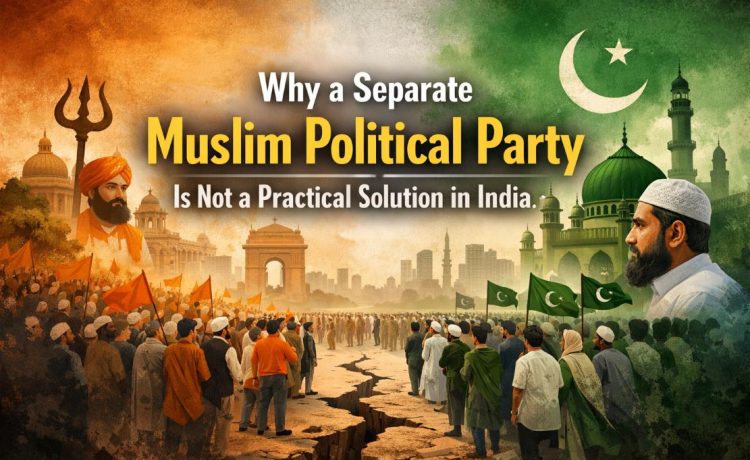
Why a Separate Muslim Political Party Is Not a Practical Solution
By: Mohammed Hidayathulla
Whenever the condition of Muslims worsens, there is a renewed call that Muslims should form their own political party. Many activists and well-meaning people genuinely believe that only an independent Muslim party can protect community interests. While the intention is sincere, this idea is not practical in the Indian political context.
The first and most basic issue is numbers. In India, Muslims cannot win even a single Assembly constituency purely on Muslim votes, except in a few rare pockets. This is true even for local bodies. Electoral victories require non-Muslim support. A party that is seen as exclusive to Muslims will find it extremely difficult to attract that support. Without numbers, political parties remain symbolic, not effective.
History confirms this reality.
Many Muslim political parties have been formed after Independence. None of them have survived as serious political forces. Either they failed electorally, or they were absorbed, divided, or destroyed by larger political parties. Indian politics does not allow small minority-based parties to grow independently once they begin to show influence.
I have heard this from my father and from several of his colleagues who were directly involved in politics during that period.
My father was an active member of the Muslim League both before and after Partition. In the early 1960s, the Muslim League was very strong in Karnataka, especially in Bangalore. It won seven seats in the Bangalore Municipal Corporation. This was a significant achievement. Encouraged by this success, the League started preparing for the Assembly elections.
This immediately alarmed the Congress leadership. Intelligence reports reached Prime Minister Indira Gandhi that the Congress could face a strong Muslim League challenge in Karnataka. Kengal Hanumanthaiah was the Chief Minister at that time. Indira Gandhi summoned him and clearly instructed that the Muslim League should be finished before the elections. He was given full authority to do whatever was required.
The General Secretary of the Muslim League in Karnataka was Rashid Khan. He was a well-known tailor in Chickpet, famous for stitching sherwanis. He was also a close family friend and had a long political association with my father. Kengal Hanumanthaiah was his regular customer and knew him personally.
After meeting Indira Gandhi, Hanumanthaiah came directly to Rashid Khan’s shop and conveyed the instructions he had received. He made an offer: ₹25,000 in cash, a substantial amount in late 1960s, a bungalow in Jayamahal or RMV Extension, and a Rajya Sabha seat. In return, Rashid Khan had to dissociate himself from the Muslim League, after which the Congress would ensure that the League was dismantled. This offer was made purely because of their personal friendship.
Rashid Khan rejected the offer outright. He told the Chief Minister that he would not bargain away the community for personal gain. He was an honest and clean-handed person. Unfortunately, not everyone is like Rashid Khan.
There are so-called leaders within the community who either have entered politics or are trying to enter it, and who repeatedly advise the formation of a separate Muslim political party. For many of them, this advice is not driven by principle or concern for the community. It is often driven by the possibility of quick money, personal bargaining power, or at least visibility within the community, which can later be converted into personal gain.
The discussion between Rashid Khan and the Chief Minister became heated. Hanumanthaiah then bluntly said that in the coming elections he would buy Muslim votes for ₹5 each.
That is exactly what happened.
During the elections, money was distributed. The Muslim electorate, like many others, voted for the Congress. The Muslim League lost badly. After that, the Congress created internal divisions within the League, encouraged defections, and weakened the organisation from inside. Within a short time, the Muslim League was politically finished in Bangalore.
This episode clearly shows how major political parties operate. Small parties, even if they are sincere and principled, cannot survive against the money power, organisational strength, administrative control, and political influence of national parties. When large parties feel threatened, they do not compete fairly. They co-opt leaders, divide organisations, or eliminate them completely.
This is not limited to one period or one party. It has happened repeatedly across India.
Therefore, the idea of forming a separate Muslim political party, though emotionally appealing, is strategically unsound. Instead of strengthening the community, it often isolates it further and makes it easier for major parties to ignore Muslim concerns or exploit internal divisions.
Political influence in India has never come from isolation. It has come from engagement, alliances, and negotiation within larger political platforms. Muslims have secured rights and representation only when they worked within broader secular parties or supported leaders committed to constitutional values and social justice.
The real challenge is not the absence of a Muslim political party. The challenge is the absence of long-term political strategy—building influence within mainstream parties, forming issue-based alliances, and maintaining sustained engagement rather than emotional, short-term mobilisation.
Indian politics rewards those who understand power as it exists, not as they wish it to be. For Muslims, political survival lies not in standing alone, but in engaging wisely and strategically within the system.









Thanks for the tips you have contributed here. Yet another thing I would like to talk about is that computer system memory specifications generally increase along with other developments in the know-how. For instance, any time new generations of cpus are brought to the market, there’s usually an equivalent increase in the scale preferences of both the computer memory along with hard drive space. This is because the program operated simply by these cpus will inevitably boost in power to take advantage of the new technological innovation.
whoah this blog is magnificent i love reading your posts. Keep up the good work! You know, a lot of people are searching around for this information, you can help them greatly.
Loving the info on this site, you have done great job on the blog posts.