

Academic Freedom Under Fire: Mob Violence and Legal Retaliation Rock Azim Premji University
BENGALURU – A violent confrontation at Azim Premji University (APU) has ignited a fierce national debate over the “fragility” of open discussion in Indian higher education. What began as a student-led reading circle has spiraled into a complex legal battle involving allegations of trespassing, assault, and a controversial decision by the university administration to prosecute its own students.
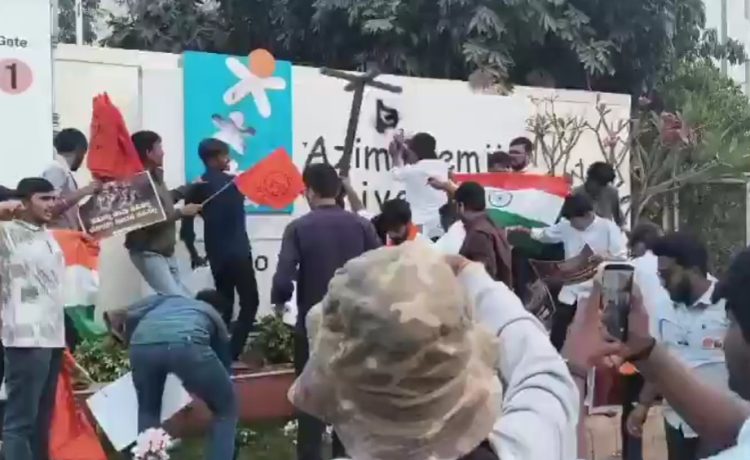
On February 24, 2026, members of the Akhil Bharatiya Vidyarthi Parishad (ABVP) allegedly stormed the APU campus in Sarjapura. The group was reportedly incensed by an Instagram post from the “Spark Reading Circle,” a student organization that had announced a discussion on the 1991 Kunan-Poshpora incident in Kashmir—a documented case of alleged mass human rights violations that the protesters labeled “anti-national.”
From Dialogue to Disorder
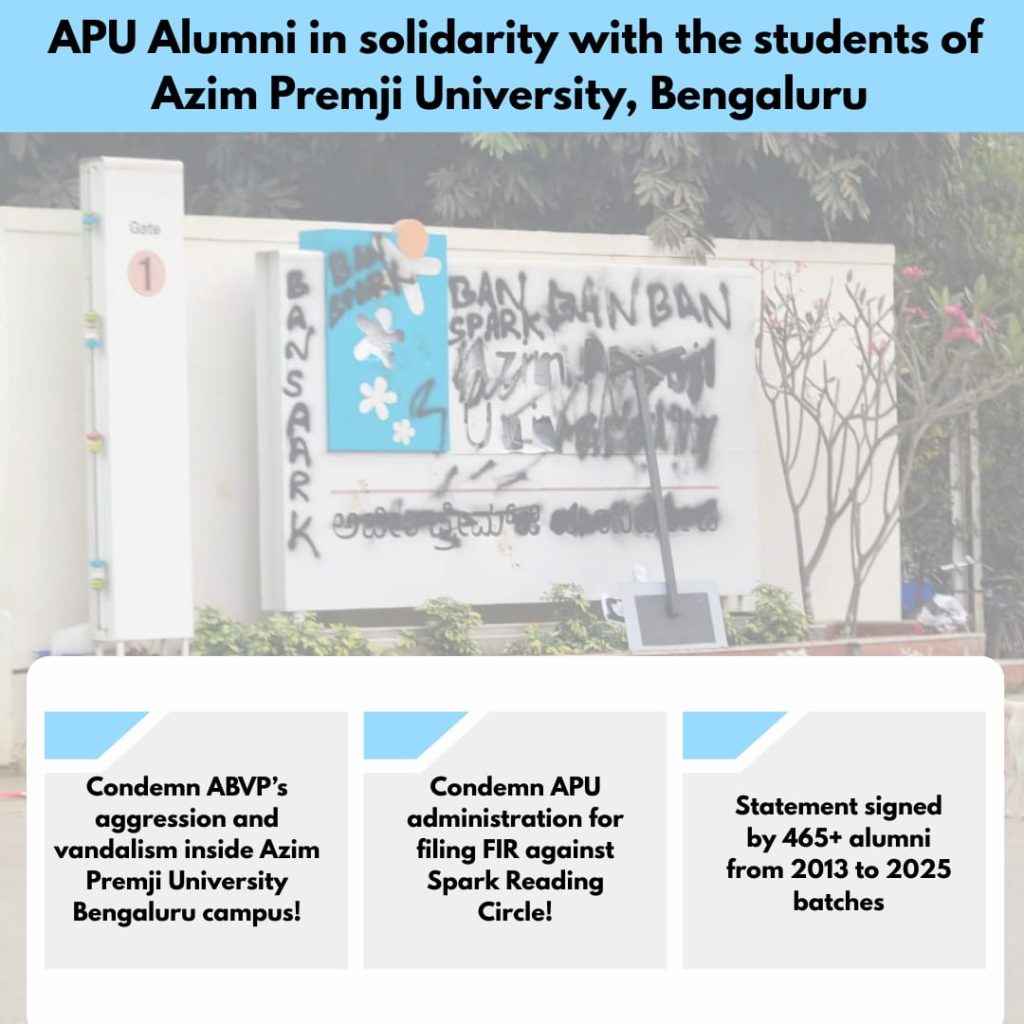
Witnesses describe a scene of escalating chaos as protesters gathered outside the gates, waving flags and shouting slogans. The situation turned physical when individuals bypassed security, allegedly assaulting guards and a first-year BA student. The campus signboard was defaced with black paint and slogans demanding bans on student groups like SPARK and AISA.
The People’s Union for Civil Liberties (PUCL) Karnataka has characterized the incident as a breakdown of the rule of law. In a scathing statement, the civil rights body invoked the Supreme Court’s ruling in Tehseen Poonawalla v. Union of India, which warned that vigilantism “under the guise of protection of the law” leads to an “epidemic of anarchy.”
“Universities must protect the spirit of critical inquiry, not surrender to the blackmail of mob violence,” the PUCL stated, condemning what they described as “feckless university administrations” caving to outside pressure.
The Registrar’s Controversial Counter-Move
While the Sarjapur Police eventually arrested 20 individuals involved in the riot, the university’s internal response has drawn sharp criticism. Rather than solely pursuing those who trespassed, APU Registrar Rishikesh BS filed a separate criminal complaint against the Spark Reading Circle.
The university’s complaint alleges that the student group defamed the institution and instigated enmity by discussing the Kunan-Poshpora incident without faculty permission. Consequently, police have registered cases against student organizers under the IT Act and the Bharatiya Nyay Sanhita (BNS) for “outraging religious feelings” and “obscenity.”
Legal experts and civil rights advocates find these charges baffling. The Kunan-Poshpora incident has been documented by Human Rights Watch and the United Nations, and is a subject of significant academic literature. “The police have failed to apply their mind to facts which do not constitute any crime,” the PUCL noted, adding that it is “beyond comprehension” how a reading circle on a historical event could be interpreted as obscenity.
A Culture of Impunity
The APU incident is not an isolated one. Similar disruptions have recently been reported at Dr. Hari Singh Gour University in Madhya Pradesh, as well as at JNU and Jadavpur University. Journalists and activists suggest these events point toward a “calculated strategy to intimidate the spirit of inquiry into silence.”
Karnataka Home Minister Dr. G. Parameshwara has condemned the violence, asserting that seminar topics cannot be unilaterally interpreted by mobs. He has promised strict action against those who take the law into their own hands.
The Mandate of Care
The university’s mission statement, which promises to “care for the well-being of each individual,” is now under scrutiny. Critics argue that by weaponizing the law against its own students, the administration has abandoned its fundamental role of fostering humanism and scientific temper.
As the legal proceedings continue, the PUCL has called for the Government of Karnataka to unilaterally withdraw the prosecution against the students. “Remembering injustices is an act of resistance,” the organization stated, standing in solidarity with the students who sought only to discuss a painful chapter of history.
The question remains: Can the modern Indian university remain a sanctuary for difficult conversations, or will the “tumultuous dark clouds of vigilantism” continue to shroud the pursuit of knowledge?











Wow that was unusual. I just wrote an incredibly long comment but after I clicked submit my comment didn’t appear. Grrrr… well I’m not writing all that over again. Anyway, just wanted to say excellent blog!