

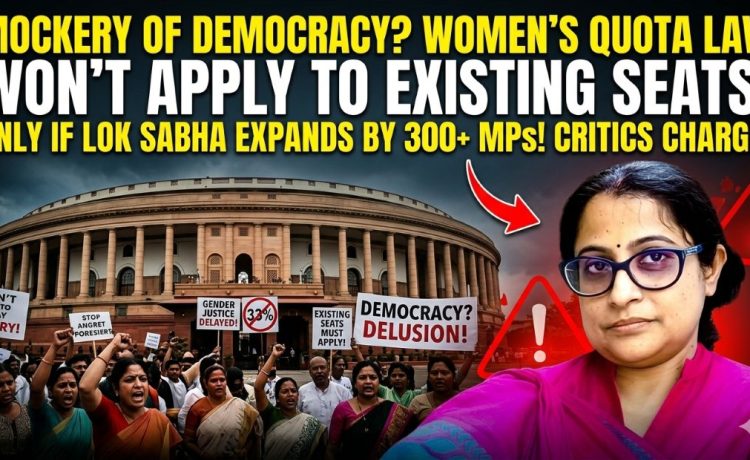
Activists warn linking 33% quota to seat increase may add financial burden and serve political interests
New Delhi – More than a year after India’s Parliament passed the historic Women’s Reservation Bill, a fresh political storm is brewing over the government’s decision to link its implementation to a yet-to-be-completed delimitation exercise. The law, which guarantees 33% of seats in the Lok Sabha and state assemblies to women, was passed in 2023 but will only take effect in 2029—and critics say the conditions attached threaten to undermine its very purpose.
“What the central government is trying to do is link women’s reservation with delimitation—the redrawing and reallocation of seats in the Lok Sabha and Rajya Sabha,” said Payel Sengupta, a rights activist, in an exclusive statement. “In other words, it is being made conditional. The bill will be implemented only if the number of Lok Sabha seats is increased—and even then, only in the newly added seats. Existing seats will not have reservation.”
Media Updates: +91-93531 21474 [WhatsApp] | indianowme@gmail.com
A Strategic Move or Democratic Mockery?
Opposition parties have protested the government’s stance, arguing that delaying women’s representation until after a politically sensitive delimitation exercise amounts to holding back constitutional reform for electoral gain.
According to critics, the ruling Bharatiya Janata Party (BJP) is reportedly planning to prioritise delimitation in regions where it enjoys stronger support—primarily the Hindi heartland. Based on population growth data, which some argue has not been effectively managed in those states over the past five decades, the number of Lok Sabha seats could increase, potentially securing a long-term majority for the ruling party.
Linking women’s reservation with this process, Sengupta said, “is a mockery of law and democracy.”
The Cost of Expanding Parliament
The current strength of the Lok Sabha stands at 543 members. Activist groups and some economists have raised concerns over a possible expansion to 850 MPs if delimitation proceeds alongside the women’s quota.
“The country is already struggling to sustain 543 MPs with taxpayers’ money,” Sengupta noted. “Due to corruption and malpractice by many MPs, the situation is already difficult. Please don’t put the burden of maintaining 850 MPs on the shoulders of the people.”
Estimates suggest that maintaining a single MP—including salaries, daily allowances, phone, medical, travel, and other benefits—costs approximately ₹8–10 lakh per month. A nearly 60% increase in the number of MPs would add thousands of crores to the annual budget, with similar cascading effects on state assemblies, where the number of MLAs could rise by 2,000 to 3,000.
“Can any economically strained country handle such a burden?” Sengupta asked.
Who Would the Quota Really Benefit?
Beyond the financial argument, deeper concerns have emerged over which women would actually enter Parliament under the reserved seats.
“Given the current political scenario, among this 33% women’s quota, there will be no representation from middle-class, lower-class, poor, labourer, or farmer families,” Sengupta said. “Instead, there will be megastars like Hema Malini, Jaya Bachchan, Smriti Irani, or Yusuf Pathan—people whose political understanding is close to zero, or even negative.”
The activist suggested an alternative: “If there is so much concern for women, then instead of 33%, provide 50% reservation for women in fields like CGL, CHSL, MTS, CPO, MBBS, IIT, IIM, etc. There will be no problem and no protest.”
Political Will Under Scrutiny
Sengupta also pointed to a glaring contradiction in the ruling party’s record: “The BJP is in power in 20 states, yet there is only one woman Chief Minister. If there is real concern, why not hand over power to women in 8–10 states?”
She concluded with a sharp warning: “In the name of women’s reservation, political interests are being served. The people of the country will not be fooled by such tactics anymore. Enough of slogans—please stop now. If you genuinely want to provide reservation, then do it from the existing 543 seats. Don’t burden the people of the country just to serve political interests.”
As the 2029 deadline approaches, the debate over how—and whether—India delivers on its promise of political representation for women is far from settled. For now, the women’s quota remains law on paper, but its future hangs in the balance of a much larger political realignment.
— End of article —








Good analysis. At the same time if seats increase tax burden of common people would multiply. That is also a concern.
Women’s bill is an enabler. The political party in power must switch it’s male members seats with female members and lead the change.
It’s a real Mockery. However, I like to remember Swami Vivekanda, who told no noble mission can be accomplished with Cleverly actions.
Its a BJP drama
🚨 Women deserve justice, not political drama! 💔
7:30 – Voting result came… delimitation bill didn’t pass
7:45 – Lok Sabha adjourned
8:00 – Suddenly posters, slogans, and blame game begin
Is this governance or pre-planned politics?
When it comes to women’s empowerment, actions matter more than staged narratives. If the intent was genuine, why wasn’t the groundwork done to ensure the bill passed?
Women of this country are not props for political messaging. They deserve real representation, real policies, and real commitment — not optics.
💬 It’s time to ask questions.
💬 It’s time to demand accountability.
Stop the drama. Start delivering.
#WomenReservation #Accountability #IndianPolitics #WomenEmpowerment #SpeakUp #RealityCheck
Very well analysed Payal ji !!! Thank you for the enlightenment on this crucial matter. This is a perfect example of hiding a sinister & dangerous agenda behind a so-called women’s bill. Shame on this Govt.
This is just a smoke screen to cover up the Balkanisation of India…the ulterior motive is consolidation of power by surgically breaking the country and creating a rift among the regions ..Evil design by the Evil duo..
Thought provoking
Both delimitation and women reservation are separate issues, must not be combined for implementation
Good Articulation