

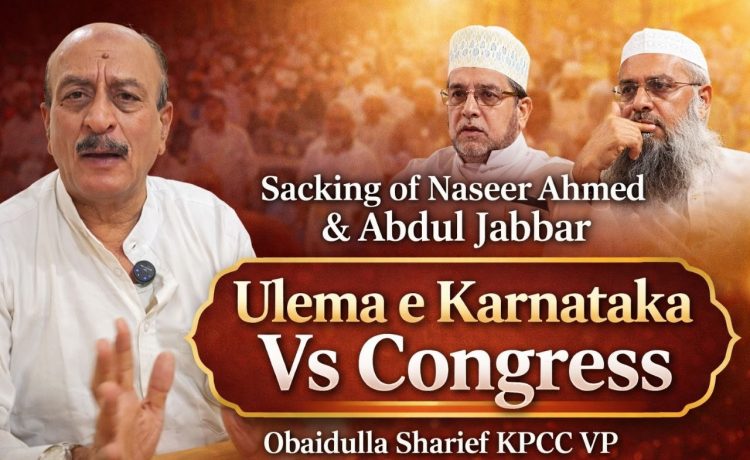
Congress-Ulema Row Deepens in Karnataka Over Disciplinary Action and Representation Concerns
Bengaluru: A fresh political controversy has erupted in Karnataka after a group of Islamic scholars, under the banner of Ulema-e-Karnataka, publicly criticized the Congress leadership over disciplinary action against party leaders, triggering a sharp rebuttal from senior party functionaries. The developments have brought into focus questions of party discipline, minority representation, and the role of religious voices in political discourse.
Ulema Question Congress Leadership Decisions
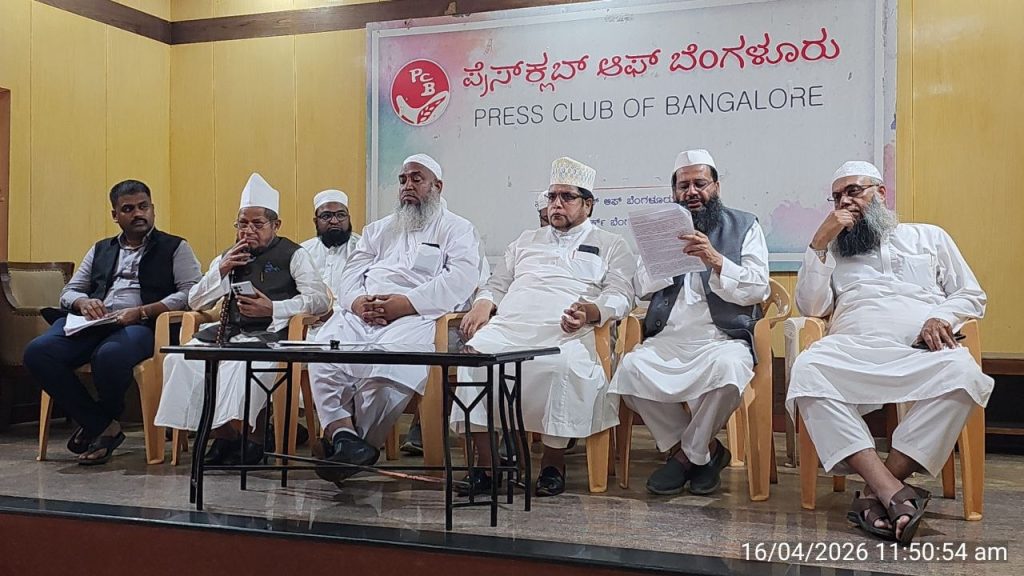
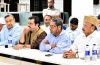
At a recent press conference, members of Ulema-e-Karnataka expressed strong dissatisfaction with the Congress high command and state leadership for removing Political Secretary to the Chief Minister, Naseer Ahmed, and suspending MLC Abdul Jabbar from the party’s primary membership.
Raising concerns over the process, one of the scholars questioned, “Is this how party discipline works? Others have spoken against the party on record, yet no action was taken.” The group maintained that their intention was to voice concerns rather than issue threats to the party.
They further alleged that the timing of the disciplinary action—prior to the declaration of by-election results in Davanagere South—was questionable. “Mistakes are being made by Congress leadership. If they are not corrected, it will have consequences,” a speaker warned.
The scholars also dismissed allegations that Muslim leaders had supported rival parties, stating that no evidence had been presented to substantiate such claims.
Concerns Over Representation and Unfulfilled Promises
The Ulema claimed that despite significant electoral support from the Muslim community, adequate political representation had not been ensured. They pointed to an alleged unfulfilled promise of fielding a Muslim candidate in the Davanagere South by-election.
“Muslims had united and worked for the Congress in recent elections but were not given due representation,” a speaker said, adding that the community now feels sidelined despite playing a key role in the party’s success.
They also cited dissatisfaction over unresolved issues such as the hijab controversy, 4% reservation demands, anti-cattle slaughter laws, and anti-conversion legislation.
In a veiled warning, the group indicated a possible political shift, stating, “We are not without options. We will support those political parties who respect our rights.” Another speaker added, “If one path closes, there are many others. We will decide our next step after consultation.”
Allegations of Anti-Party Activities Surface
The controversy is rooted in the backdrop of the Davanagere South by-election, where allegations have emerged against senior leaders including Naseer Ahmed, Abdul Jabbar, and Cabinet Minister Zameer Ahmed Khan for alleged anti-party activities.
Zameer Ahmed Khan, in particular, has faced accusations of not actively campaigning for the Congress candidate and allegedly aiding rival candidates—claims that remain politically sensitive and contested.
Congress Hits Back, Defends Disciplinary Action
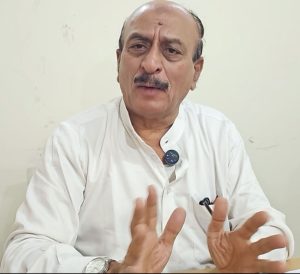
Responding to the allegations, Karnataka Congress Vice President Obaidulla Sharif held a separate press conference, strongly defending the party’s decisions and questioning the legitimacy of the Ulema group’s claims.
Sharif acknowledged the presence of “a small group of well-known individuals” at the press conference but rejected their claim of representing the entire Muslim community in Karnataka. “We respect their opinions, but they cannot claim to speak for the whole community,” he said.
‘Action Based on Intelligence Inputs,’ Says Congress
Clarifying the party’s stance, Sharif stated that the disciplinary measures were taken based on intelligence reports received by the leadership. He revealed that Chief Minister Siddaramaiah was dissatisfied with Naseer Ahmed’s alleged non-compliance with election responsibilities, leading to his removal.
He confirmed that Abdul Jabbar’s suspension was carried out under the direction of the state unit president, D.K. Shivakumar, and emphasized that further action could follow.
“The high command, Chief Minister, and Deputy Chief Minister have received reports about individuals working against the Congress candidate. Action will be taken to maintain party discipline,” Sharif asserted.
Questions on Religious Influence in Politics
Sharif also raised broader concerns about the role of religious leaders in political matters. Questioning the Ulema’s intervention, he asked, “Do political parties need permission from religious leaders before taking disciplinary action against their own members?”
Drawing parallels, he added that political decisions are internal matters and should not be subject to external religious approval.
Muslim Voting Patterns and Internal Sabotage Claims
Highlighting the electoral contribution of the Muslim community, Sharif said that a significant number of Muslim voters supported the Congress despite alleged attempts to disrupt voting patterns.
“Attempts were made to damage the Muslim community’s voting efforts, but they proved to be aware and resilient. A large number of Muslims voted for Congress,” he said, adding that efforts to sabotage these votes ultimately failed.
Allegations, Rumours, and Internal Dynamics
Sharif also addressed speculation surrounding the Ulema press conference, suggesting possible political motivations behind the event. He hinted at the involvement of individuals with longstanding affiliations to certain leaders and even a retired official allegedly influencing the initiative.
Without naming individuals, he noted that serious allegations—such as funding rival candidates and mobilizing support against the party—had been made, and appropriate action would be taken at the “right time.”
“There are serious allegations against certain politicians. The party will act appropriately when the time comes,” he said, indicating that investigations or internal reviews may be ongoing.
A Growing Rift with Political Implications
The exchange between Ulema-e-Karnataka and the Congress leadership underscores a growing rift that could have broader political implications, particularly in terms of minority outreach and internal party cohesion.
While the Ulema have warned of exploring alternative political options, the Congress leadership appears firm on maintaining discipline and autonomy in decision-making.
As the situation unfolds, the episode highlights the delicate balance between community expectations and party governance in Karnataka’s evolving political landscape.
Congress–Ulema Clash Erupts in Karnataka Over Discipline, Representation, and By-Poll Fallout
Obaidullah Sharif, referring to an earlier press conference addressed by MLA Rizwan Arshad and MLC Saleem Ahmed, stated that the decision to field Samarth from the Davanagere South Assembly constituency was taken by the party high command. He emphasized that all party members—from grassroots workers to senior ministers—were expected to work collectively to ensure the victory of the official candidate. However, he indicated that this unity of effort appeared to be lacking on the ground.








Time to thik of Harmony, not about Hindu Muslim favorism