


Activist Raises Alarm Over Alleged Trafficking Networks, Questions Document Drives in Northern India
Payel Sengupta warns of possible exploitation of vulnerable communities amid bureaucratic exercises, drawing controversial parallels with global trafficking scandals
A rights activist has sparked debate by alleging the existence of organized trafficking networks targeting young girls in parts of India, while questioning whether recent document verification drives in states like West Bengal, Bihar, and Uttar Pradesh are being misused by intermediaries and brokers.
Allegations and Concerns Over “Collection Drives”
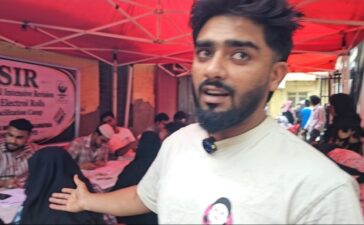
Payel Sengupta, a rights activist and media consultant, has raised serious concerns over what she describes as a “collection drive” that requires citizens to produce documents and stand in long queues for verification processes. According to her, such exercises—particularly those conducted with significant public mobilization—may inadvertently create opportunities for exploitation.
She questioned whether the process is “scripted for brokers and middlemen,” suggesting that vulnerable populations could be exposed to manipulation under the guise of administrative procedures.
Sengupta further pointed to the absence of legal action against certain public claims as a factor that, in her view, deepens suspicion. “One thing is not adding up,” she remarked, indicating a perceived gap between allegations and institutional response.
Claims of Organized Trafficking
In her remarks, Sengupta alleged that politically influential individuals, “wearing the mask of respectability,” could be involved in trafficking young girls from smaller towns and rural areas to metropolitan cities such as Delhi and Mumbai, and potentially beyond India’s borders.
She drew a controversial comparison to the infamous global trafficking scandal associated with financier Jeffrey Epstein, suggesting that vulnerable girls could be subjected to exploitation and then “forced into a land of no return.”
“These children vanish without a trace,” she said, adding that families are often left in prolonged distress. “Parents run from one police station to another, filing missing complaints, but many cases remain unresolved.”
Human Cost and Social Impact
The activist highlighted the emotional and psychological toll on families of missing children, describing a cycle of despair where relatives spend years searching for answers. In many cases, she claimed, families are left with no closure, leading to long-term trauma and social isolation.
“The pain of losing a child under such circumstances is unbearable,” Sengupta said, emphasizing the need for stronger safeguards and accountability mechanisms.
Media Updates: +91-93531 21474 [WhatsApp] | indianowme@gmail.com
Critique of Power and Accountability
Sengupta also criticized what she perceives as a culture of impunity among powerful individuals. Using a metaphor, she remarked that outward appearances or status cannot conceal deeper systemic issues.
“A crow remains a crow, even if adorned with peacock feathers,” she said, implying that wealth or influence cannot erase ethical failings.
She further argued that such “social sins” persist due to blind allegiance and lack of scrutiny, warning that societal complacency may enable exploitation to continue unchecked.
Political Undertones and Public Reaction
The activist’s statements also carried political undertones, as she questioned governance and accountability at multiple levels. Her remarks have circulated widely on social media, drawing both support and criticism.
While some users echoed concerns about trafficking and systemic vulnerabilities, others cautioned against making sweeping allegations without concrete evidence.
Broader Context
India has long grappled with issues of human trafficking, particularly involving women and children from economically disadvantaged backgrounds. Government agencies and civil society organizations have implemented various measures to combat trafficking, including stricter laws and awareness campaigns. However, enforcement challenges and gaps in coordination remain persistent concerns.
Experts note that while vigilance is necessary, allegations of organized trafficking involving influential actors require thorough investigation and substantiation to avoid misinformation and panic.
Questions That Remain
- Are large-scale document verification drives being adequately monitored to prevent exploitation by intermediaries?
- What mechanisms exist to track and resolve missing persons cases more effectively?
- How can authorities ensure accountability when allegations involve powerful individuals?
- Is there sufficient transparency in investigating claims of trafficking networks?
- And most importantly, how can vulnerable families be protected from falling into cycles of despair and uncertainty?








Women’s Safety is Non-Negotiable.
A safe city is not built by fear, silence, or blame — it is built by awareness, accountability, and action.
Every woman deserves:
✔ Freedom to walk without fear
✔ Respect in every space — home, workplace, public
✔ Quick and strict action against any form of harassment or violence
As a community, we must:
• Speak up against wrongdoing, not ignore it
• Support victims, not question them
• Demand faster police response and stronger local safety systems
• Ensure proper lighting, CCTV, and patrols in every area
Safety is not just a “women’s issue” — it is a society’s responsibility.
I stand committed to creating safer neighborhoods in our ward, where every daughter, sister, and mother feels secure and respected.
Let’s build a Bengaluru where safety is a right, not a privilege.
#WomenSafety #SafeBengaluru #ResponsibleLeadership
Renuka H
BNP Ward Leader
Well said Renuka
Absolutely. You have raised critical questions here. … The blind allegiance, the impunity…. And the continued behaviour of such individuals in our societies is terrible. There has to be zero tolerance
Thanks Madam
I will not comment on the allegations that are made but I do believe that investigations should be fast tracked and quick actions should be taken to find missing persons and severe punishments should be meted out to the imposters. Moreover, the safety of women should be the primary priority of any government of any state and adequate steps should be taken so that women may feel safe and live their life without any fear.
I agree regarding the urgency and importance of the matters you have raised. The protection of women and children from human trafficking is a critical priority. It is deeply concerning that legal frameworks can be undermined when influential individuals are involved.
We must remain committed to addressing and opposing any atrocities committed against women. Thank you for bringing necessary attention to this vital issue.
Thanks sir
Government authorities to take more interest in this subject. Failing which it will be a disaster. With missing children number increasing and no count of sexual harrassment.
True
When one voice rises against injustice, it should echo through all of us. Payel Sengupta madam has taken a bold stand against human trafficking—an issue that continues to destroy the lives of helpless women and children.
This is not just her fight. It is our collective responsibility to speak up, act, and demand justice.
It is heartbreaking that such a serious issue still remains unresolved, leaving victims’ families in pain and silence—often overshadowed by powerful influences.
Let’s not stay silent anymore.
Let’s stand together.
Let’s raise our voices for those who cannot.
All these questions asked are valid ones + this missing children’s issue is deeply concerning too… But will Government take this seriously?? Answer is NO..
Not a single politician talks about it in press or in the parliament, but I am sure, they’re fully aware of this situation, that’s the saddest part… Nobody cares about the general public!! 🙁
Very rightly and powerfully pointed out Payal ji ✌️✌️✌️ Kudos to you 🙏 There is absolutely no compromise on women safety especially against human trafficking. While the Govt continues to sleep over this, it’s time for us public to go to the extent when we can really wake them. We stand with you in solidarity with this Fight, however long it may be !!!