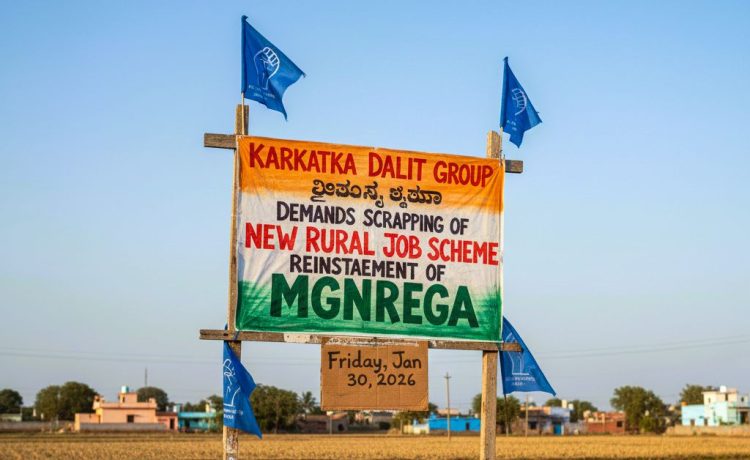
Dalit Sena alleges central government’s VB-G Ram Ji Yojana undermines workers’ rights, could worsen rural distress; calls on state CM to intervene.
By Manoj Kumar, Correspondent
Bengaluru, 29 January: The Dalit Sena has called for the immediate scrapping of the newly introduced Viksit Bharat Grameen Udyog Guarantee and Livelihood Mission (VB-G Ram Ji Yojana) and the restoration of the Mahatma Gandhi National Rural Employment Guarantee Act (MGNREGA) in its original form.
In a strongly worded statement issued on Thursday, the organization warned that replacing the landmark rural jobs scheme with the new program would strip vulnerable communities of legal employment guarantees, exacerbating unemployment and distress migration in rural Karnataka and across India.
“ವಿಬಿ-ಜಿ ರಾಮ್ ಜಿ ಯೋಜನೆ ರದ್ದು ಮಾಡಿ, ಮನರೇಗಾ ಪುನರಾರಂಭಿಸಲು ದಲಿತ ಸೇನೆಯು ಸಿಎಂ ಆಗ್ರಹ”
A Scheme Under Fire
The VB-G Ram Ji Yojana, introduced by the central government, has faced criticism from workers’ rights groups since its announcement. The Dalit Sena’s state organizing secretary, Javed Khan, articulated these concerns, stating the move to supplant MGNREGA has caused “deep anxiety and outrage.”
“For two decades, MGNREGA has provided livelihood security to rural wage labourers, women, Dalits, and small and marginal farmers across the country, including in rural Karnataka,” Khan said. “Weakening this scheme and replacing it with the VB-G Ram Ji Yojana is an attempt to dilute the rights of workers.” 
Core Concerns: From Rights to “Charity”
The primary objection centres on the fundamental shift from a rights-based framework to a potentially discretionary one. Khan outlined key differences that activists find problematic.
“MGNREGA provided a legal right to work on demand. However, the new VB-G Ram Ji Yojana, with its cap on work days, the possibility of being denied work during agricultural seasons, and the centralization of fund allocation, is an effort to snatch away these hard-won rights,” he explained. “This could plunge the rural poor, especially women and the unorganized workforce, into severe difficulty.”
The group argues that features like workday limits and central control over funding convert a guaranteed social safety net into a restricted welfare program, leaving workers more vulnerable to economic shocks.
Democratic Process Questioned
Beyond the policy details, the Dalit Sena has raised alarms about the process of enacting such a significant change. Khan criticized the lack of broad consultation before rolling out the new scheme.
“Implementing such a major policy shift without comprehensive discussion with workers’ unions, farmers’ associations, state governments, and the public, and without adequate debate in the legislative assembly and parliament, is contrary to democratic values,” he stated. “The consequence will be increased migration from rural areas and a serious worsening of unemployment.”
Call to State Leadership
Appealing directly to the Karnataka Chief Minister, the Dalit Sena framed the issue as a test of pro-poor commitment. They urged the state government to take a firm stand against the central scheme.
“As a Chief Minister known for your stance on social justice and pro-poor policies, the state government must strongly oppose the VB-G Ram Ji Yojana,” Khan urged. “Pressure must be put on the central government to continue MGNREGA with its original spirit. The 100-day work right, timely wage payments, and the scheme’s autonomy based on Gram Panchayats must be protected.”
The demand sets the stage for potential political friction, placing the onus on the state government to defend a scheme long considered a vital lifeline for millions in rural India.