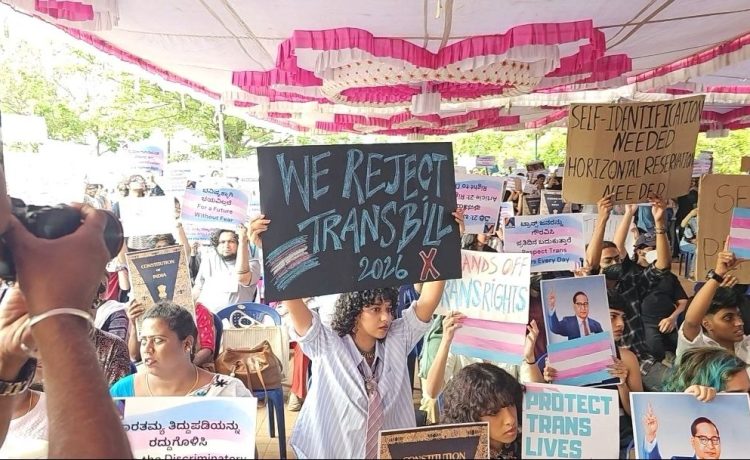
Activists Demand Withdrawal of Transgender Rights Amendment Bill, Calling It a “Regressive Setback”
A coalition of rights groups condemns proposed legislation that they argue replaces self-determination with bureaucratic oversight, narrowing the legal definition of transgender identity and threatening hard-won constitutional protections.
A Challenge to Self-Determination
A network of organisations and individuals working for the rights of women and marginalised genders, operating under the banner Naveddu Nilladiddare (“If We Do Not Rise, Karnataka”), has issued a sharp condemnation of the Transgender Persons (Protection of Rights) Amendment Bill, 2026. Introduced in the Lok Sabha on March 13 by Union Minister for Social Justice and Empowerment Virendra Kumar, the proposed legislation seeks to amend the Transgender Persons (Protection of Rights) Act of 2019.
According to the collective, the amendment represents a profound setback—not only for transgender rights but for all feminist struggles grounded in bodily autonomy and dignity. While the government claims the Bill aims to provide a “precise” definition of transgender persons and strengthen protections against certain crimes, activists argue it will instead perpetuate fresh exclusions and weaken access to social welfare schemes.
Eroding Constitutional Guarantees
Central to the opposition is the Bill’s removal of the principle of self-perceived gender identity—a right affirmed by the Supreme Court in its landmark NALSA judgment. The court had held that the right to self-identify one’s gender is fundamental under Articles 14, 19, and 21 of the Constitution, requiring no medical certification or state approval.
The 2019 Act had given statutory expression to this guarantee. The current amendment, however, reintroduces a system whereby legal recognition depends on certification by a District Magistrate based on a medical board’s recommendation.
“This move relegitimises long-standing patriarchal practices where institutions—legal, medical, bureaucratic and cultural—exercise control over how individuals define and experience their own bodies,” the collective stated.
A Narrowing Definition
Equally concerning to the coalition is the Bill’s restricted definition of a “transgender person.” While the 2019 Act recognised a wide spectrum of identities—including trans men, trans women, gender-queer persons, and intersex individuals—the amendment seeks to confine recognition primarily to specific socio-cultural communities such as hijra, kinner, aravani, and jogta, or to persons with congenital intersex variations.
“This move imposes rigid, culturally restrictive categories on what is inherently a diverse, fluid and lived experience,” the press release noted, warning that such narrowing erases those whose identities do not conform to these boundaries.
The collective also condemned the Bill’s use of the term “eunuch” as deeply regressive and dehumanising, noting its echoes of colonial-era laws such as the Criminal Tribes Act, 1871.
Criminalisation Concerns
Another provision drawing fire is one that would penalise anyone who compels a person to “outwardly present a transgender identity.” Activists warn that, read alongside the Bill’s narrowed definition, this risks framing self-identified gender as a product of coercion rather than legitimate expression.
“It risks targeting transgender communities and their informal support networks, which have historically provided safety in the absence of state protection,” the statement read. Alarmingly, the punishment for such alleged “compulsion” is harsher than that for discrimination against transgender persons.
Demands for Withdrawal
The coalition has demanded that the Amendment Bill, 2026, be immediately and fully withdrawn and referred to the Parliamentary Standing Committee on Social Justice and Empowerment for comprehensive review. They further called for democratic consultations involving members from all transgender, intersex, non-binary, and genderqueer communities, ensuring that those consulted reflect the full diversity of language, caste, region, religion, gender, and sexual orientation as recognised in the NALSA judgment.
“This amendment bill, as introduced, defers justice itself,” the collective said, invoking poet Langston Hughes. “As Langston Hughes asked: What happens to a dream deferred? This deferral cannot stand.”