“Our School, Our Fight”: Villagers Protest Against Karnataka’s School Merger Plan
Nelamangala / Bengaluru: In a passionate display of grassroots resistance, parents and activists in Nelamangala’s Lohith Nagara have launched a movement to shield their local government school from closure, directly challenging the Karnataka state government’s controversial KPS (Kasturba Patil Shaale) “Magnet School” consolidation policy. Their cry—”Our village government school belongs to us!”—echoes a growing anxiety across the state, where the scheme could shutter up to 40,000 schools deemed to have low enrollment.
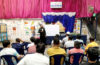
The recently formed “Lohith Nagar Save Public Education Committee” emerged from a charged parents’ meeting, positioning itself as the vanguard of a larger struggle to protect public education. The meeting served as a platform to voice deep-seated grievances against what participants label a systemic dismantling of the government schooling system.
Karnataka / Bengaluru
“ನಮ್ಮ ಶಾಲೆ, ನಮ್ಮ ಹೋರಾಟ”: ಕೆಪಿಎಸ್ ‘ಮ್ಯಾಗ್ನೆಟ್’ ಯೋಜನೆಗೆ ಗ್ರಾಮೀಣರು ಎದುರಾಗಿದ್ದಾರೆ
Parents in Nelamangala launch a fierce protest against Karnataka’s KPS “Magnet School” policy, which threatens to close ~40,000 govt schools.
Citing safety fears for kids… pic.twitter.com/7cJ7QvYxbC
— RafeeQ Jabbar Naqshbandi (@azzharee) January 4, 2026
A “Massacre” of Public Education?
Speakers at the gathering framed the Magnet scheme not as an educational reform, but as a fatal blow to an already weakened system. Kalyan Kumar, District Secretary of the All India Democratic Students’ Organisation (AIDSO), Bengaluru, launched a broadside against state and central governments, accusing them of uniformly pursuing policies that destroy public education.
“Today, the policy of all governments is the same: to destroy public education,” Kumar asserted. “This is not just a problem in Karnataka; a massacre of government schools is happening across the entire country.”
He argued that the government itself is responsible for the declining enrollment it cites as justification for closures. “Schools are being closed under the lame excuse of ‘low student enrollment,'” he said. “However, we must ask why there are no children in these schools. Thousands of teacher posts are vacant; the existing teachers are not allowed to teach but are instead made to wander for non-educational tasks like ‘dog census’ work.”

Concerns Over Safety, Transparency, and Hollow Promises
Beyond the principle of accessible local education, practical and safety concerns dominated the discourse. Parents, particularly mothers, expressed acute fear over the prospect of sending young children, especially girls, to schools located far from their villages.
“In an era where there is no safety for girls, how can we send small children to schools located far outside the village?” questioned Kumar, highlighting a critical vulnerability in the consolidation model. He further punctured the government’s promise of logistical support, stating, “The promise of ‘free buses’ remains merely an assurance, while the ordeal of travel falls upon the parents.”
The scheme’s funding also came under scrutiny. Kumar pointed to a lack of transparency surrounding a ₹2,000 crore loan from the Asian Development Bank (ADB) that is reportedly linked to the project. “The conditions of the loan… remain a mystery to this day,” he added, fueling suspicions about the policy’s driving forces.
A Call to Arms, Inspired by History
Invoking the legacy of social reformer Savitribai Phule, hailed as the “Mother of Education” in India, speakers framed the current moment as a historical battle for the soul of public education. They drew a stark contrast between Phule’s struggle to establish schools for the marginalized and the current state’s move to close them.

Media Updates: +91-93531 21474 [WhatsApp] | indianowme@gmail.com
“Mother of Education, Savitribai Phule, once endured cruel insults and had dung and stones thrown at her while fighting for public education. But today, the ruling governments are conspiring to snatch away that very education,” Kumar told the assembled crowd. His speech culminated in a call for organized protest: “We must not wait silently until our village schools are closed. To realize the dream of equal education envisioned by Phule and to protect public education, we must take to the streets and fight.”
The meeting, presided over by Prakruthi, an AIDSO Bengaluru District Secretariat member, concluded with a resolve to intensify the campaign. As the newly formed committee mobilizes, the protest in Lohith Nagara signals the start of what could become a widespread rural pushback against a policy that many fear will irreparably damage educational access for Karnataka’s most vulnerable children.