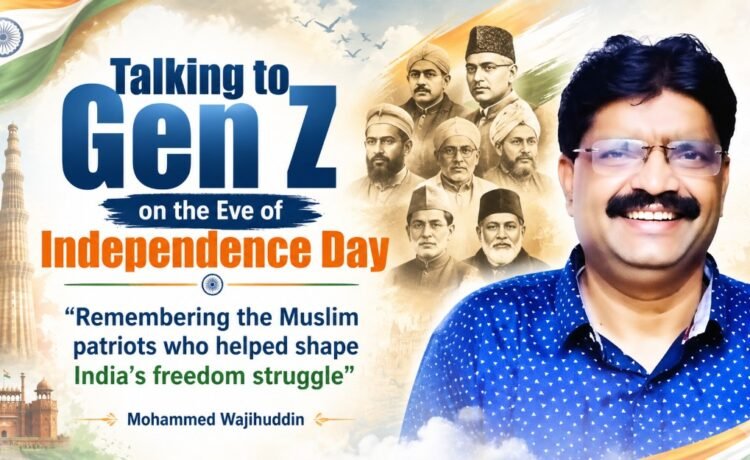
Talking to Gen Z on the Eve of Independence Day
Remembering the Muslim patriots who helped shape India’s freedom struggle
By Mohammed Wajihuddin
Ideally, a discussion on the role of Muslims in India’s freedom struggle should not require justification. Yet, in a time when the patriotism of Indian Muslims is sometimes questioned and they are expected to repeatedly prove their loyalty to the country, recalling the contributions of Muslim patriots and freedom fighters becomes both necessary and meaningful.
That was the context in which I addressed students at Rizvi College of Arts, Science and Commerce in Bandra West, Mumbai, on the eve of Independence Day. The Department of Urdu had invited me to speak on “Hindustan Ki Azadi Mein Musalmanon Ka Kirdar”, or “The Role of Muslims in India’s Independence”.
The audience was predominantly young, with more girls than boys filling the hall. The interaction offered an opportunity not only to revisit history, but also to reflect on how today’s generation understands the country’s past and its responsibilities towards the future.
From Plassey to 1857: A long resistance to British rule
Professor Abdul Hafeez Khan of the Urdu Department, who anchored the programme, opened the event with Urdu couplets and recalled the participation of Muslims in the First War of Independence in 1857.
I took the students further back in history, arguing that the resistance to British expansion had deep roots and that the Battle of Plassey in 1757 marked a decisive turning point. The defeat of Siraj ud-Daulah, aided by betrayal within his own ranks, strengthened the East India Company’s hold over Bengal and paved the way for further British expansion.
The defeats of several Indian rulers who resisted the Company’s growing influence followed. The defeat of Tipu Sultan, in particular, dealt a major blow to the confidence of many Indian rulers who had resisted British expansion. Gradually, several Indian states were brought under British influence.
A century after Plassey, the uprising of 1857 became one of the most significant challenges to British rule. Indian soldiers, along with rulers, civilians and religious leaders, rose against the colonial administration. The rebels rallied around the ageing Mughal emperor Bahadur Shah Zafar, who was declared their leader.
The uprising was eventually crushed with extraordinary brutality. Bahadur Shah Zafar, who had taken refuge at Humayun’s Tomb after leaving the Red Fort, was captured and subsequently exiled to Rangoon, where he died in 1862.
Clerics and journalists among those who paid the price
The Mughal Empire of that period cannot simply be described as an Islamic state. Nevertheless, many Muslim religious scholars and clerics opposed British rule, regarding the East India Company’s expansion as an assault on the established political order. Some also feared the growing influence of Christian missionaries.
The British responded harshly to those they accused of encouraging or participating in the uprising. Muslim clerics were among those subjected to brutal reprisals. In several places, religious scholars were publicly executed and their bodies left hanging as a warning to others.
One of the most tragic examples was Maulvi Mohammed Baqar, editor and owner of the Delhi Urdu Akhbar. He was accused of supporting the uprising and was executed by being tied to the mouth of a cannon. He is remembered as one of the earliest Indian journalists to be martyred in the struggle against British rule.
The stories of such individuals, I told the students, are not merely stories of one community. They form part of India’s larger and often painful journey towards freedom.
Mohammed Ali Jauhar: From Oxford to the freedom struggle
Among the other patriots I spoke about was Maulana Mohammed Ali Jauhar, one of the most influential Muslim leaders of the freedom movement.
Born in Rampur in present-day Uttar Pradesh, Jauhar studied at Aligarh and later at Oxford. His elder brother, Shaukat Ali, was also educated at Aligarh and was a talented cricketer who later entered the provincial services.
Shaukat Ali supported his brother financially while Mohammed Ali was in England preparing for the Indian Civil Service examinations. Jauhar did not succeed in the examination. In retrospect, his failure may have been a blessing for the freedom movement. India gained a committed nationalist who chose political struggle over a career in the colonial bureaucracy.
Jauhar returned to India and became deeply involved in the freedom movement. He worked closely with Mahatma Gandhi and played an important role in the Khilafat Movement. In 1920, he and his associates invited Gandhi to address the Khilafat gathering in Bombay.
The movement also had an important educational legacy. Jauhar, along with his associates and with the support of the renowned Islamic scholar and freedom fighter Maulana Mahmood Hasan, played a role in the establishment of Jamia Millia Islamia in October 1920. Mahmood Hasan, who had been arrested in Mecca and imprisoned in Malta by the British, was among the influential figures associated with the anti-colonial movement.
Jamia Millia Islamia was later shifted to Delhi, and Mohammed Ali Jauhar became its first Vice-Chancellor.
Jauhar also understood the power of journalism. With command over both Urdu and English, he edited Comrade in English and Hamdard in Urdu, using the press as an instrument of political mobilisation and resistance.
Bi Amman and the courage of a mother’s call
The Ali brothers’ mother, Abadi Begum, popularly known as Bi Amman, also emerged as a respected figure during the Khilafat and freedom movements.
Her courage and public speeches inspired many people. A popular slogan associated with her appeal to her sons captured the spirit of sacrifice that defined the movement: “Boli Amma Mohammed Ali Ki, Jaan De Do Khilafat Pe Beta.”
Her story is a reminder that the freedom movement was not fought only by men who stood at political podiums or led armies. Women, mothers, writers, journalists, students and ordinary citizens also contributed to the national struggle.
Abul Kalam Azad: Principles above personal suffering
Maulana Abul Kalam Azad was another towering figure whose contribution to India’s freedom struggle cannot be overlooked.
Born in Mecca and brought up largely in Calcutta, Azad was home-educated and largely self-taught. He went on to become a distinguished Islamic scholar, an exceptional orator and one of the most influential Urdu writers of his generation.
Azad spent more than a decade in British prisons because of his political activities. Yet imprisonment did not persuade him to compromise his principles.
One episode illustrates the personal price he paid for his commitment.
While Azad was imprisoned in Ahmednagar Fort, he was informed that his wife was seriously ill in Calcutta. The British authorities indicated that he could be released on parole if he submitted a request and sought permission to visit her.
Azad refused to petition the colonial government for mercy. His wife died while he remained imprisoned. Months later, after his release, he visited her grave in Kolkata, where he reportedly wept for the grief he had been forced to suppress during his imprisonment.
For the young audience, this was not merely a historical anecdote. It was a story about conviction, sacrifice and the personal costs that freedom fighters were willing to bear.
“You do not have to prove your patriotism”
I told the students, particularly those who may feel disheartened by attempts to question their patriotism, that they should not carry the burden of constantly proving their loyalty to India.
Those who demanded a separate nation ultimately got one and left. Those who remained chose to stay in India because this was their home.
India’s freedom struggle was not the achievement of one community, religion, language or region. Hindus, Muslims, Sikhs, Christians and people from different social and political backgrounds participated in the struggle. After Independence, people from these diverse communities also contributed to building the country.
The contribution of Muslims to India’s freedom movement, therefore, should not be treated as a favour or as an argument in a political debate. It is part of India’s documented history.
A worrying question: Are young people still reading?
The programme also exposed a more contemporary concern.
Shaikh Haseena, the college supervisor, asked the students how many of them regularly read newspapers. To my disappointment, only one hand went up.
Both Principal Dr Anjum Ara Ahmed and I urged the students to reduce their screen time and develop the habit of reading newspapers. I particularly encouraged them to read printed newspapers, while also being mindful of the need to verify information consumed through digital platforms.
The concern goes beyond newspapers.
A generation growing up amid social media algorithms, manipulated content, misinformation and incomplete accounts of history can easily become vulnerable to distorted narratives. The question is not simply whether young people read newspapers, but whether they are developing the ability to distinguish fact from fiction and history from propaganda.
That responsibility cannot be placed entirely on students. Parents, teachers, journalists, historians and other professionals must also step forward.
Gen Z needs guidance, not lectures
Gen Z is undoubtedly far ahead of previous generations in its use of technology. Young people today navigate digital platforms with an ease that many from older generations can only admire.
But technological familiarity does not automatically translate into historical awareness, critical thinking or civic responsibility.
Professionals from different fields must therefore make time to engage with young people. Journalists can discuss media literacy. Historians can explain the complexities of the past. Scientists can encourage curiosity. Teachers can nurture critical thinking. Public figures can help young citizens understand their rights and responsibilities.
Young people do not need to be lectured at. They need to be heard, engaged and guided.
The future belongs to the young
As Independence Day approached, I left the college with a sense that the few hours spent with those young students had been worthwhile.
They are India’s future. In the coming years, they will decide not only what kind of careers they build for themselves, but also what kind of society and country India becomes.
The stories of India’s freedom fighters, including its Muslim patriots, belong to all Indians. Remembering them is not about seeking validation for any community. It is about protecting the integrity of India’s history and ensuring that the next generation inherits a fuller, more truthful understanding of the country it will shape.
Jai Hind.
(The author is a journalist with The Times of India, Mumbai.)