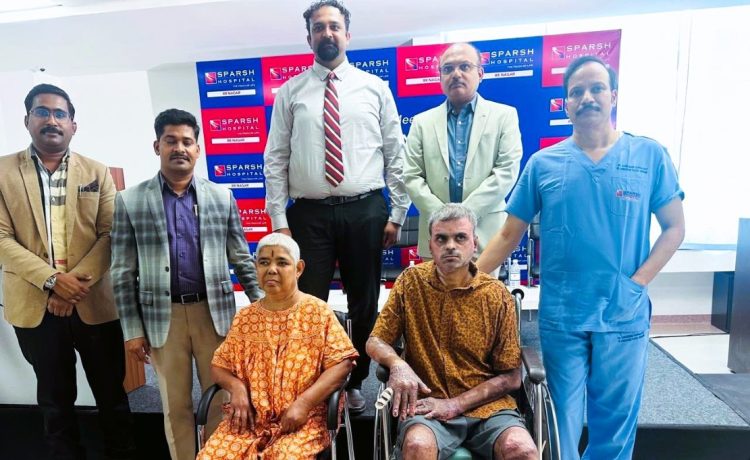
SPARSH Hospital Launches Coordinated Mass-Casualty Response to Treat Victims of Mysore Road Industrial Fire
Bengaluru, March 31, 2026 – In a demonstration of institutional preparedness, SPARSH Hospital in RR Nagar successfully managed the treatment of five critically injured burn victims following an industrial fire at a textile design printing factory on Mysore Road on the evening of February 1. The incident highlighted the hospital’s capacity to handle high-acuity mass-casualty emergencies through rapid coordination and specialized infrastructure.
The five patients, who sustained severe burns to the face, hands, and back, were initially provided first-line emergency care at a nearby hospital before being transferred to SPARSH Hospital. Leveraging its strategic location and arterial road connectivity, the hospital was able to receive the patients within the critical golden hour. One individual, suffering from severe inhalation burns, presented with a compromised airway requiring immediate intervention.
Upon receiving the alert, the hospital activated its mass-casualty and burn management protocols. A multidisciplinary emergency team was assembled within minutes, and dedicated ICU beds were mobilized to ensure readiness for prolonged intensive care, advanced nutritional support, and metabolic management essential for severe burn cases. Upon arrival, the patients were rapidly triaged and stabilized, while medical staff provided counselling to their families regarding the severity of injuries and the treatment plan.
The clinical response was spearheaded by Dr. Gunasekar Vuppalapati, Senior Consultant – Plastic Surgery, and Dr. Deepak K L, Senior Consultant – Aesthetic and Reconstructive Plastic Surgery. They were supported by a multidisciplinary team comprising intensivists, anesthesiologists, critical care specialists, specialized burn nurses, nutrition experts, and physiotherapists. To ensure uninterrupted high-dependency care, the hospital deployed 21 trained nurses in rotational shifts, enabling 1:1 monitoring for all five patients.
Over the subsequent five hours, the team delivered coordinated emergency interventions. The patient with severe inhalation injury underwent emergency intubation and advanced airway support, while individualized burn management plans were initiated for all individuals.
“Severe burns are life-threatening and require immediate, structured intervention,” said Dr. Gunasekar Vuppalapati. “Beyond fluid resuscitation, the challenge is preventing a cytokine storm—an extreme immune overreaction that can damage vital organs—along with metabolic collapse, hypothermia, and infection. The first 48 hours are critical. Our focus was airway stabilization, precise fluid management, temperature control, aggressive wound care, and high-protein nutritional support, delivered through seamless coordination between the surgical, ICU, and nursing team.”
Following the emergency intervention, four patients were stabilized and discharged in stable condition. One patient was later shifted to another hospital at the family’s request.
Commenting on the institution’s response, Dr. Ranjan Shetty, Group Medical Director at SPARSH Hospitals, stated, “Managing multiple critically injured patients simultaneously reflects the strength of institutional preparedness, experienced clinical leadership, and integrated ICU infrastructure. Our response demonstrates sustained investment in advanced protocols and emergency readiness.”
Mr. Jasdeep Singh, Group CEO of SPARSH Hospitals, reinforced the organization’s commitment to systemic resilience. “At SPARSH, emergency readiness is built into our operating model. From scalable critical care infrastructure and rapid resource mobilization to standardized mass-casualty protocols across the network, we have invested consistently in systems that enable swift, coordinated action. Our RR Nagar facility reflects the group’s commitment to preparedness, resilience, and patient-first critical care delivery.”
Equipped with surge-ready ICU infrastructure and rapid-response clinical teams, SPARSH Hospital RR Nagar continues to affirm its role in managing high-acuity emergencies, underscoring a sustained commitment to advanced burn care and integrated critical care systems.