Milli Council Opposes Mandatory ‘Vande Mataram’ Law, Calls It a Threat to Constitutional and Religious Freedom
Organisation Urges Centre to Review Legislation, Says Patriotism Cannot Be Enforced Through Criminal Law
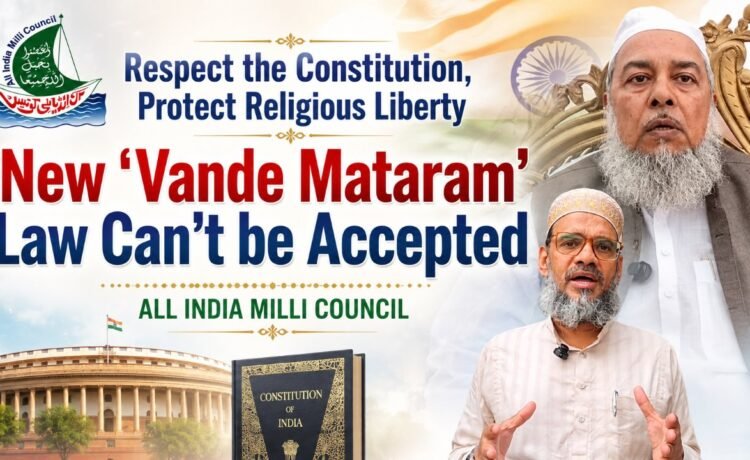
New Delhi, 02 August 2026: The All India Milli Council (AIMC) has strongly opposed the passage of a new law by both Houses of Parliament making compliance with revised ‘Vande Mataram’ provisions mandatory. Describing the legislation as an attack on India’s constitutional framework, secular ethos and religious freedom, the organisation has urged the Union Government to reconsider the measure in the interest of justice, constitutional values and national harmony.
In a statement issued from the Council’s central office, AIMC Working President Maulana Aneesur Rahman Qasmi said the amendment, introduced under the Prevention of Insults to National Honour Act, 1971, goes beyond protecting national dignity and instead seeks to impose a particular religious concept upon all citizens through legislation.
‘Constitution Does Not Permit Imposition of Religious Beliefs’
Reacting to the development, Maulana Qasmi said that compelling citizens to follow a particular religious or ideological expression contradicts the very spirit of the Indian Constitution.
“India’s strength lies in its secular and pluralistic character. No democratic government should impose a specific religious concept or belief upon every citizen through legislation,” said Maulana Aneesur Rahman Qasmi.
He recalled that former Prime Minister Jawaharlal Nehru, after extensive consultations and considering the concerns of the Muslim community, had accepted only the first two stanzas of Vande Mataram for national use, while the remaining portions were not considered compatible with India’s secular character.
Religious Freedom Must Be Protected
The Council stated that certain portions of Vande Mataram portray the nation as a goddess and invite worship, which, it said, conflicts with the Islamic principle of Tawhid (absolute monotheism).
“Muslims consider love for their motherland a religious as well as civic responsibility. However, they cannot accord the status of deity or object of worship to the nation, as worship is reserved solely for Almighty Allah,” Maulana Qasmi said.
The statement stressed that patriotism and religious belief are not mutually exclusive and that constitutional protections must ensure every citizen can express love for the country without compromising sincerely held religious convictions.
Appeal for Constitutional Review
Referring to a previous Supreme Court judgment, Maulana Qasmi said the apex court had held that no individual could be penalised merely for abstaining from a particular act if participation conflicted with genuine religious beliefs.
He argued that the newly passed legislation, by criminalising non-participation under the guise of protecting national honour, raises serious constitutional concerns.
“This legislation appears to conflict with Articles 19 and 25 of the Constitution, which guarantee freedom of expression and freedom of religion. Constitutional rights must remain paramount in a democratic republic,” he said.
The All India Milli Council urged the Government of India to review the legislation and ensure that national unity is strengthened through dialogue, mutual respect and constitutional safeguards rather than legal compulsion. It maintained that preserving India’s democratic, secular and inclusive traditions is essential for safeguarding the rights and dignity of every citizen.
KEY QUOTES:
“Love for one’s motherland is an integral part of our faith and civic duty, but devotion and worship belong only to Almighty Allah. Patriotism and religious conviction can coexist with dignity.”
— Maulana Aneesur Rahman Qasmi
“If a law undermines the fundamental rights guaranteed under Articles 19 and 25 of the Constitution, it deserves careful review in the larger interest of justice and democracy.”
— Sulaiman Khan
“We respectfully urge the Government of India to review this legislation in the spirit of constitutional morality, religious freedom and India’s enduring pluralistic tradition.”
— Maulana Aneesur Rahman Qasmi
“India’s greatest strength lies in its unity amidst diversity. Preserving the constitutional rights and dignity of every citizen is the surest path to lasting national harmony.”
— Maulana Aneesur Rahman Qasmi