“Questioning Is Not a Crime”: ‘Dimagi Naxal’ Label Sparks Debate Over Free Thought and Dissent
by Dinesh Kumar
“ಭಿನ್ನಮತ ನಕ್ಸಲಿಸಂ ಅಲ್ಲ”: ‘ದಿಮಾಗೀ ನಕ್ಸಲ್’ ಹೇಳಿಕೆಗೆ ಪ್ರಜಾಪ್ರಭುತ್ವದ ಸ್ವಾತಂತ್ರ್ಯದ ಪ್ರಶ್ನೆ
Critics question whether branding ideological opponents as ‘intellectual Naxals’ risks blurring the line between violent extremism and legitimate democratic dissent
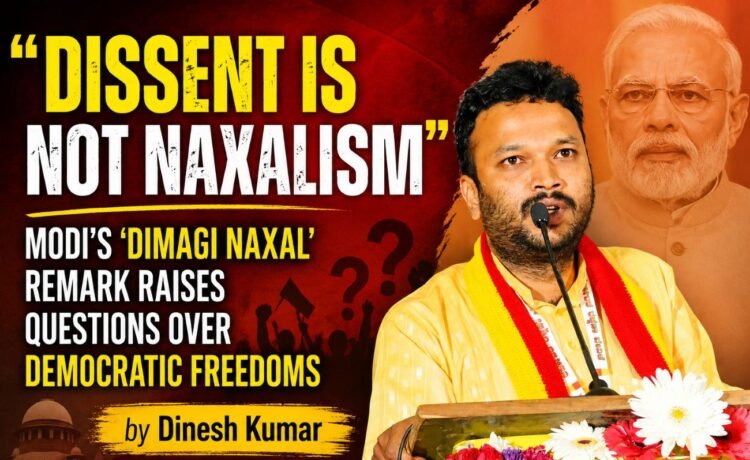
Prime Minister Narendra Modi’s use of the term “Dimagi Naxals” (intellectual Naxals) in his Independence Day address has triggered a wider debate over the language used to describe dissent in a democracy. The phrase raises a fundamental question: can an armed insurgency and intellectual, social or political criticism of government policies be placed within the same conceptual framework?
There is little dispute that the State must act against individuals or organisations engaged in armed violence and activities that threaten national security. However, if the fight against armed Naxalism is extended to those who are perceived to share or support its ideological positions, the government must clearly define who falls within that category and on what grounds.
Who qualifies as a ‘Dimagi Naxal’?
The expression has no precise legal definition, raising concerns about how broadly it could be applied. Would it include a journalist questioning government policy, a writer criticising economic decisions, a poet highlighting social injustice, an activist defending tribal rights, a lawyer supporting people displaced by development projects, or a student expressing dissent on a university campus?
The distinction between dissent and criminal conduct, critics argue, must remain clear. “Dissent is not sedition. Criticism of the government is not an act against the nation. Questioning authority is not Naxalism,” is the central argument behind the concern.
A citizen may be held accountable for an unlawful act, an inciting speech or writing that promotes violence. But treating a person’s thoughts or political beliefs as evidence of criminality could significantly narrow the space for civil liberties.
Questioning power is part of democracy
A functioning democracy does not require citizens to agree with the government. It requires institutions in power to respond to questions raised by citizens. The right to support a government necessarily carries with it the right to criticise and challenge it.
History has repeatedly shown how political systems can begin by describing critics as dangerous, then anti-national, and eventually as enemies. Critics of the term fear that vague labels can similarly delegitimise opposition and create an atmosphere in which people become hesitant to express independent views.
If “Dimagi Naxal” is intended specifically to describe individuals or organisations providing intellectual support to armed Naxal groups, the criteria should be made public. What conduct, statement, organisation, law or evidence would justify such a designation?
Freedom must include the freedom to question
Independence Day, critics contend, should reinforce not only freedom from colonial rule but also the freedom of citizens to question their own elected government. “Do not be afraid. Ask questions” would be a more democratic message, they argue.
The debate does not require any defence of armed violence. Naxalism and violent extremism can be firmly opposed while protecting the legitimate right to think differently.
The State can use its power against a gun, but an idea cannot be defeated merely by labelling it. It must be answered with another idea. A democracy needs not obedient minds, but citizens capable of thinking independently while remaining within the framework of the Constitution.
The concern, therefore, is not merely about a phrase. It is about where the boundary between combating violence and suppressing dissent is drawn. If that boundary becomes blurred, critics warn, the consequences could extend far beyond Naxalism to the broader democratic space itself.