


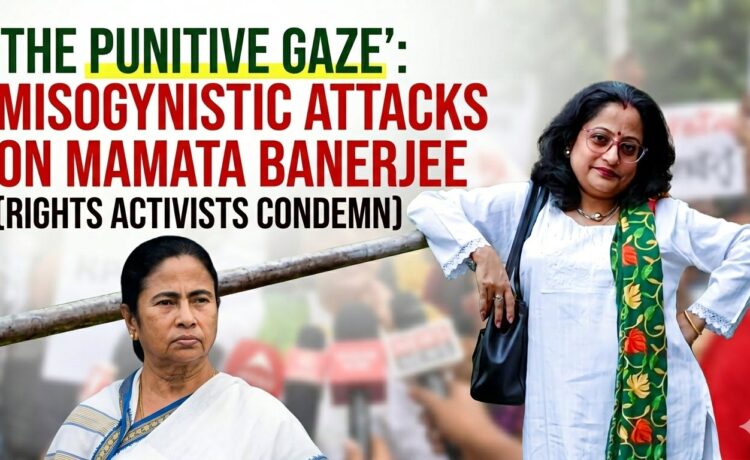
‘The Punitive Gaze’: Rights Activists Condemn Misogynistic Attacks on West Bengal CM
KOLKATA – A digital firestorm has erupted following the circulation of a derogatory cartoon targeting West Bengal Chief Minister Mamata Banerjee. The incident, which originated from an X (formerly Twitter) handle based in Uttar Pradesh, has sparked a fierce debate over the rising tide of “state-sponsored misogyny” and the weaponization of the female body in Indian politics.
The controversial image, which graphically mocks the Chief Minister’s anatomy, has been flagged by rights activists as a dangerous escalation in political discourse. Unlike standard political satire, observers argue this represents a targeted attempt to strip a female leader of her dignity through what experts call the “punitive gaze.”
Beyond Politics: The Weaponization of the Body
Rights activist and media consultant Payel Sengupta argues that the attack transcends political rivalry. While the handle responsible openly aligns with the Hindutva ideology of the central government, the silence from top leadership in New Delhi and Lucknow has been described as deafening.
“The politics of West Bengal’s Chief Minister Mamata Banerjee will be answered by her state—through EVMs, in courts, and in Parliament,” Sengupta stated. “The body is not the place for that answer.”
The lack of formal apologies or arrests in connection with the post has led activists to label the phenomenon as “state-sponsored misogyny.” The critique suggests that by failing to police such content, the state tacitly approves of using sexualized humiliation as a tool for political suppression.
Understanding the ‘Punitive Gaze’
The discourse surrounding this incident distinguishes between the traditional “male gaze” and a more aggressive “punitive gaze.” While the former objectifies women for visual consumption, the latter seeks to punish women who occupy positions of power.
The Male Gaze: Objectifies the female form.
The Punitive Gaze: Seeks to reclaim control by telling a woman in power that her body is not hers, but a weapon to be used against her.
Activists point to a glaring contradiction in the national cultural fabric: a state that publicly performs rituals worshipping feminine power—such as the veneration of Goddess Kali—while simultaneously allowing the digital desecration of a living woman leader.
“These two are not contradictions,” Sengupta noted. “This is the state’s real perspective. The same state that weeps publicly and performs rituals worshipping feminine power is the one that circulates such cartoons.”
A Dangerous Precedent for Women in Leadership
The most chilling aspect of this trend, according to advocates, is the justification used by supporters of the content. Arguments suggesting that a leader’s perceived political failures justify personal or anatomical attacks set a “new rule” for all women in the public eye.
If the “punitive gaze” becomes an accepted standard of criticism, it creates a hostile environment for any woman who dares to enter politics, regardless of her party affiliation. It suggests that her body remains a site of attack the moment she makes a mistake or faces public scrutiny.
A Call for Collective Protest
The incident has galvanized a movement to protect the dignity of women in the political sphere, moving beyond the binary of “Pro-Mamata” or “Anti-Mamata.” The core of the protest is the refusal to allow the state or its ideological supporters to become “licensed violators” of female dignity.
In a powerful closing sentiment invoking local cultural identity and strength, Sengupta emphasized the stakes of this battle:
“Those who say, ‘She is bad, so this cartoon is justified,’ are setting a trend… a rule for every woman who will ever come to power. We will not allow the state to become a licensed violator—this I swear on Mother Kali.”
As the digital footprint of the cartoon continues to spread, the demand for accountability grows, placing the spotlight on the intersection of technology, gender, and the ethics of political opposition in modern India.













Social engineering starts from home surroundings and then the schools but the ultimate boundary has to be the law and order department which is directly under the control of politicians and policy makers. Unless they are not reigned in. meaningful change in the society will be a mirage. In effect it will proactively empower the miscreants and culprits. Hence the separation of powers under constitution.
A bluff master party speaking about women’s safety for last one week in Bengal is happily spreading this pathetic cartoon with joy, once again proves that they don’t respect women at all. Crime against women in all the double engine govt ruled states are its live example & proof… 🙂
Hope voters of Bengal make the right choice .
Exactly